You Were Never in a Debate
The Wolf Was Never Looking for the Truth
They met at a stream.
Not as enemies. Not as rivals.
Just two creatures drawing water from the same place.
The lamb stood downstream.
The wolf stood above her.
The wolf spoke first.
“You’re muddying my water.”
The lamb answered calmly. Correctly.
"That cannot be true.
Water does not flow uphill."
The accusation collapsed.
So the wolf tried again.
“You insulted me last year.”
The lamb paused.
"I am six months old. I did not exist last year."
Another claim dissolved.
Then the wolf stopped pretending.
“If it wasn’t you,” he said, “it was your father.”
And with that, language ended.
Teeth replaced words.
The lamb was eaten.
This story, preserved as a fable, was never about animals.
It was about power.
The wolf did not want clarity.
He wanted permission.
Each accusation was not meant to be resolved. It was meant to feel reasonable. A way to turn appetite into justification.
Predatory power works this way.
It accuses first.
It revises the charge when facts interfere.
When facts fail, it invents history.
When history fails, it blames lineage.
When language fails, it acts.
The lamb did not fail because she was wrong.
She failed because she misunderstood the nature of the exchange.
She believed she was in a dialogue.
She was actually in a selection process.
That mistake is common.
When someone benefits from your removal, your innocence is irrelevant.
Your logic becomes ornamental.
Your cooperation becomes leverage against you.
Predatory systems often cloak themselves in moral language.
Hunger is framed as principle.
Domination is presented as righteousness.
The wolf did not prevail because he was correct.
He prevailed because he had power, inside a system where power determines outcomes.
This is a lesson many people resist because it unsettles comfortable myths.
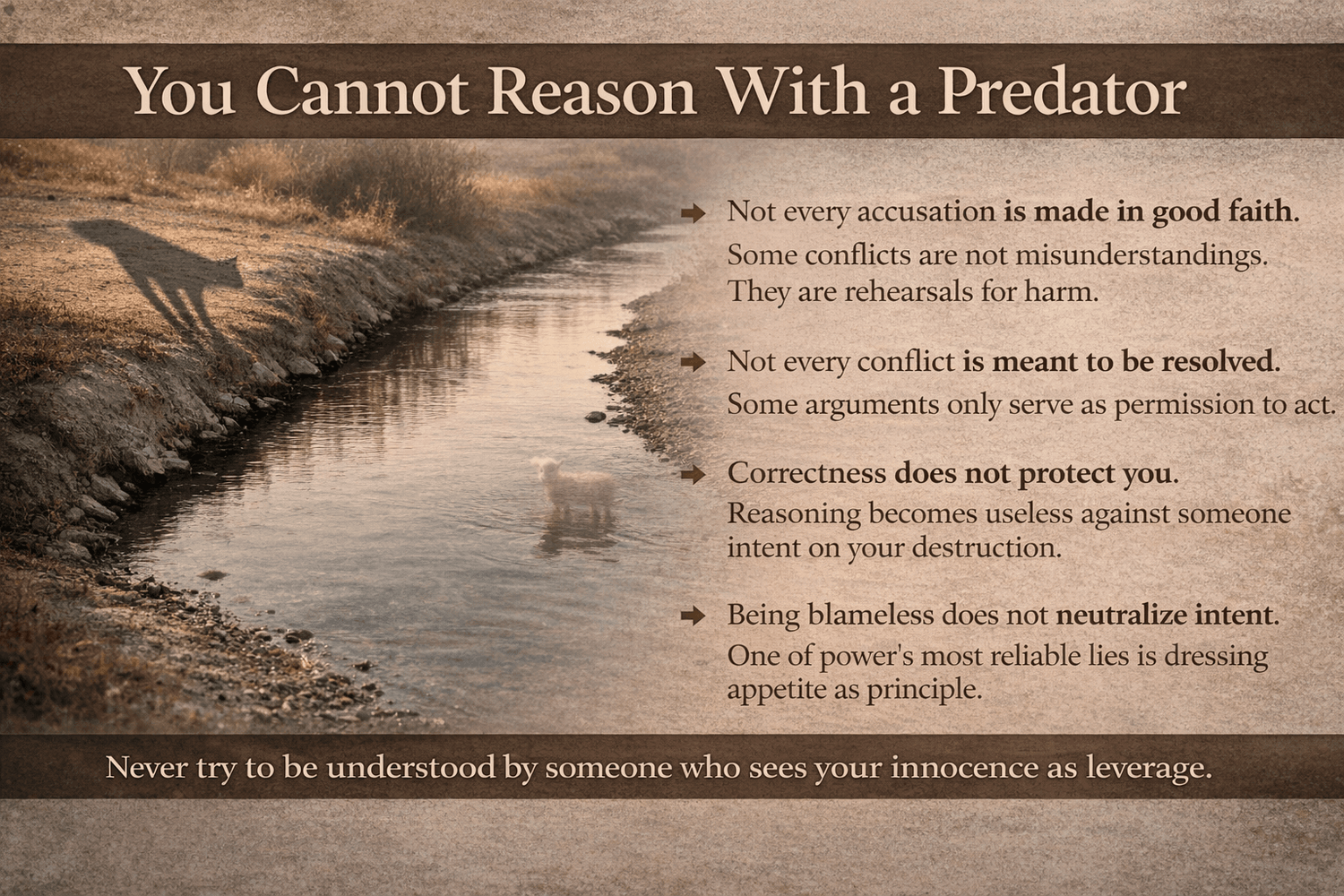
Not every accusation is made in good faith.
Not every conflict is meant to be resolved.
Some people do not want truth. They want authorization.
Correctness does not protect you.
Clarity does not guarantee safety.
Being blameless does not neutralize intent.
One of the core skills of self-leadership is discernment.
Knowing when explanation no longer serves you.
Knowing when engagement feeds the very outcome you are trying to avoid.
Knowing when to stop trying to be understood.
Never argue with someone who does not need to be right.
Never confuse morality with leverage.
In a world where wolves exist,
being right is not protection.
Power is.
This distinction between truth and power, and why it matters, is examined more fully in Mastering Your Fate.

John Webster is an author, strategist, and professional speaker who helps serious professionals turn ideas into books that create authority, leverage, and long-term positioning.
His work focuses on designing books and systems that shape perception before persuasion, emphasizing structure over noise and clarity over visibility.
Coach John Webster
Best-Selling Author
Professional Key-note Speaker
Entrepreneur Strategist
© 2026 John Webster. All Rights Reserved.